

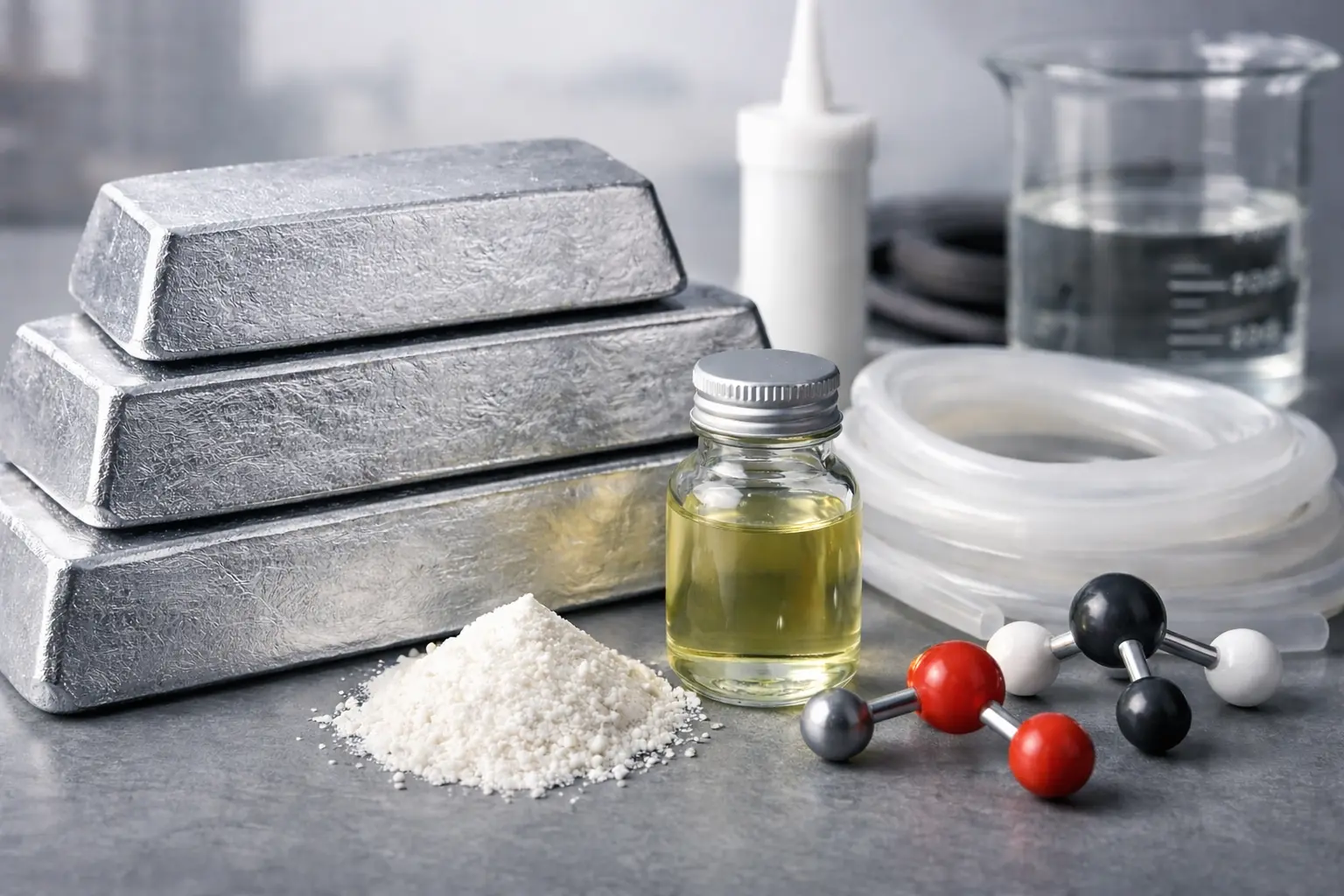
Today, silicones are indispensable across many modern industries. Their exceptional thermal stability, flexibility, weather resistance, and chemical inertness make them practically irreplaceable in construction, automotive, electronics, and healthcare applications. Yet what most people overlook is that the transformation of raw silicone polymers into functional elastomers depends heavily on one often underappreciated component: the tin catalyst.
A Tin catalyst lowers the activation energy required for curing reactions to proceed, thereby accelerating crosslinking. For manufacturers and formulators working with silicone systems, understanding how organotin catalysts function is not just useful; it is foundational to producing consistent, high-quality products. This article breaks down the practical benefits of tin-based catalysts in silicone processing.
Silicone Curing Mechanism
Silicone elastomers are produced through two distinct curing pathways: condensation curing and addition curing.
In condensation curing, tin catalysts drive the reaction between silanol groups (Si–OH) and alkoxy silanes, forming siloxane bonds (Si–O–Si) and releasing small byproducts, such as alcohols. This reaction pathway is the backbone of Room Temperature Vulcanising (RTV) silicone production.
In addition curing works differently. Here, a silicon-hydride group (Si–H) adds across a vinyl group (Si–CH=CH₂), and a platinum compound, typically the platinum-divinyltetramethyldisiloxane complex (Karstedt’s catalyst), facilitates the reaction. Because no volatile byproducts are generated, addition-cured systems deliver exceptional dimensional stability.
The table below captures the key differences between the two methods:
Table 1: Comparison of Silicone Curing Mechanisms
| Parameter | Tin-Catalysed Condensation | Platinum-Catalysed Addition |
| Curing Temperature | Room temperature or moderate heat | Requires controlled conditions |
| By-products | Alcohols or ketoximes | No by-products produced |
| Sensitivity to Impurities | Not very sensitive to impurities | Highly sensitive to impurities |
| Cost | Economical | Expensive |
| Shelf Life | Moderate | Longer than tin-catalysed silicones |
| Common Applications | Sealants, adhesives, and coatings | Medical devices and high-purity elastomers |
What Are Tin Catalysts?
Tin catalysts are coordination compounds in which tin exists in either a +2 or +4 oxidation state. Commonly referred to as organotin catalysts, they function as strong Lewis acids, making them highly effective in silicone curing, polyurethane synthesis, and esterification reactions.
The most widely used examples in industrial silicone processing include:
| Catalyst | Chemical Type | Key Features | Typical Applications |
| Dibutyltin Dilaurate (DBTDL) | Tin(IV) carboxylate | High catalytic activity | RTV sealants, coatings |
| Stannous Octoate (Tin Octoate) | Tin(II) carboxylate | Fast curing | Silicone elastomers |
| Dibutyltin Diacetate (DBTDA) | Tin(IV) compound | Moisture-sensitive curing | Adhesives and sealants |
Mechanism of Action
Tin catalysts act as Lewis acids by coordinating with the oxygen atoms present in silanol or alkoxy groups. This coordination increases the electrophilicity of the adjacent silicon atoms, thereby accelerating the formation of siloxane bonds.
In the presence of a tin catalyst, the reaction proceeds as follows:
Si–OH + Si–OR → Si–O–Si + ROH
This catalytic efficiency is not merely a convenience; it directly determines the uniformity of the crosslink density throughout the cured silicone. And crosslink density, as most formulators know, governs the mechanical performance and thermal resilience of the finished elastomer.
5 Reasons Why Tin Catalysts Are Important in Silicone Processing
1. Speeds up curing and enhances Productivity.
Among the most obvious benefits of tin catalysts is their ability to shorten cure time. Use of dibutyltin dilaurate in a formulation can reduce curing time by up to 60, depending on the formulation chemistry and processing temperature. The quicker the healing process, the higher the throughput.
2. Controls Reaction Kinetics
The concentration of catalysts offers formulators fine-tuning of pot life, gel time, crosslink density, and mechanical properties. In the case of industrial sealants and adhesives, where open time and application behaviour are required to meet specified process requirements, this degree of control is essential.
3. Enhances Mechanical and Thermal performances.
The type of crosslinking that organotin catalysts always achieve is uniform crosslinking, which produces quantifiable increases in tensile strength, elongation at break, thermal stability, and weather resistance. These are not fringe benefits; they manifest themselves regularly in the performance of finished products.
4. Allows Room Temperature Vulcanisation (RTV).
The ability of tin catalysts to cure silicone under ambient conditions eliminates the need for specialised heating devices, saving both capital expenditure and operating costs. The fact that more than 60% of silicone sealant applications are currently tin-catalysed systems speaks volumes about just how commercially important they still are.
5. Compatible with Various Formulations.
Organotin catalysts can work with a wide range of compounding ingredients, including silica and calcium carbonate fillers, plasticisers, pigments, and other functional additives. This enables the formulators to develop tailor-made silicone solutions without affecting the catalytic performance.
Table 2: Influence of Tin Catalysts on Silicone Properties
| Property | Without Catalyst | With Tin Catalyst |
| Cure Time | Very slow | Rapid |
| Tensile Strength | Moderate | High |
| Elastic Recovery | Limited | Excellent |
| Thermal Stability | Good | Superior |
| Production Efficiency | Low | High |
Examples of Industrial Applications
Owing to the versatile properties of Tin-catalyszed silicones, they are used in multiple industries like:
1) Construction industry: They find application in sealants and weather-proofing, as these materials are very strong and adhesive.
2) Automotive industry: Silicones are used in gaskets and insulation because they have good thermal and chemical resistance.
3) Electronics: As they provide good insulation, they are utilised in encapsulation and potting applications.
4) Healthcare: Uses in the field of prosthetics and tubing, the flexibility and biocompatibility are very important factors.
5) Consumer goods: Consumer goods like moulds and coatings are considered to have elasticity and long-lasting performance.

Tin Catalysts vs. Alternative Catalysts
| Parameter | Tin Catalysts | Platinum Catalysts | Emerging Alternatives |
| Cost | Low | Very High | Moderate |
| Activity | High | Very High | Variable |
| Sensitivity to Impurities | Low | High | Moderate |
| By-products | Yes | None | Depends |
| Industrial Adoption | Extensive | Extensive | Limited |
While platinum catalysts dominate addition-cure silicone systems, tin catalysts remain indispensable in condensation-cure applications. Their cost efficiency and relative robustness to common process impurities make them the practical choice for a wide range of industrial formulations.
Why SV Plastochem Tin catalysts?
At SV Plastochem, the offering goes beyond just supplying catalysts. Regular product quality and an active technical support team help manufacturers enhance process efficiency and final product performance without the risk of a weak supply chain.
Conclusion
Modern silicone technology has long been supported on the quiet backbone of tin catalysts. They not only accelerate curing but also enable very fine control over reaction kinetics and directly improve the mechanical and thermal properties of the resulting elastomers. The body of research surrounding organotin chemistry also continues to support their status as one of the most economical tools silicone formulators may have at their disposal.
With the increased worldwide manufacturing, automotive, medical, and electronics industries need high-performance silicone in their products, a reliable supplier becomes a true competitive edge. To find out more about tin catalysts and their use, visit the SV Plastochem website today.

FAQs
1. Why are tin catalysts used in silicone processing?
A Tin catalyst accelerates the condensation reaction between silanol and alkoxy groups, enabling the formation of crosslinked silicone elastomers. These elastomers are used in sealants, adhesives, and coatings.
2. Which tin catalysts are most commonly used?
The Organotin compounds, known for their high catalytic efficiency and therefore most widely used in industry, are dibutyltin dilaurate (DBTDL), stannous octoate (tin octoate), and dibutyltin diacetate.
4. Are tin catalysts safe for industrial use?
Yes, when handled in accordance with regulatory guidelines such as REACH, tin catalysts are safe and effective for industrial applications.
5. Why are tin catalysts preferred over platinum catalysts in some systems?
Tin catalysts are preferred in condensation-cure silicones due to their lower cost, robustness, and reduced sensitivity to impurities, making them ideal for large-scale industrial applications.