

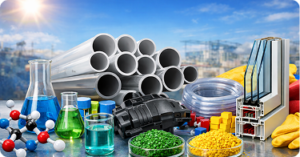
In an era where plastics permeate virtually every sector, from construction and automotive to healthcare and consumer goods, polyvinyl chloride (PVC) and related plastics remain at the forefront of material innovation. However, the remarkable versatility of these materials does not stem solely from the base polymer.
Instead, it is the speciality chemicals, advanced additives, modifiers, stabiliser, plasticizers, and performance enhancers that unlock PVC’s true potential. These speciality chemicals are not merely supplementary; they are fundamental to achieving performance, compliance, sustainability, and competitive differentiation in modern PVC and plastics applications.
Understanding Speciality Chemicals in the Plastics Context
Speciality chemicals are highly engineered, function-specific chemical products designed to impart targeted properties or solve specific challenges in complex material systems. Unlike commodity chemicals, which are produced in bulk with standardized formulations, speciality chemicals are performance-driven, often customized for precise outcomes in end-use applications.
When it comes to PVC, one of the world’s most widely produced thermoplastics, speciality chemicals play a vital role. PVC by itself is rigid, heat-sensitive, and limited in its ability to process or perform across varied conditions. It is the speciality chemical compounding that transforms PVC into a highly versatile engineering material capable of meeting stringent industrial requirements.
The Macro Importance of Speciality Chemicals in PVC & Plastics
PVC and other plastics have become indispensable across industries due to their low cost, ease of processing, and structural attributes. However, the demand for advanced properties, such as improved flexibility, enhanced weather resistance, UV protection, mechanical strength, and long-term durability, cannot be achieved by polymer resin alone. This is where speciality chemicals step in.
Speciality chemicals in PVC touch every critical performance axis:
- Processing Efficiency — additives and processing aids improve melt flow, reduce defects, and enable consistent manufacturing quality.
- Performance Under Stress — stabiliser and modifiers enhance thermal and mechanical stability, making PVC suitable for demanding environments.
- Compliance & Sustainability — emerging speciality chemicals help PVC meet evolving regulatory and safety standards without compromising performance.
- Customization & Innovation — formula-level engineering enables tailored materials for highly specific applications, from medical tubing to architectural profiles.
How Speciality Chemicals Drive Modern PVC Performance
1. Heat Stabiliser — Ensuring Processability & Longevity
PVC is inherently unstable at elevated temperatures and susceptible to degradation during the melt processing stage. Without stabiliser, PVC degrades rapidly due to dehydrochlorination, leading to color changes, loss of mechanical integrity, and processing difficulties.
Speciality heat stabiliser, often complex metal soaps, organic systems, or combinations such as barium-zinc and calcium-zinc formulations, protect PVC during extrusion and moulding. They absorb and neutralize released hydrochloric acid, prevent discoloration, prolong material life, and ensure consistent quality. Advanced stabiliser are also engineered to reduce emissions and meet strict environmental criteria, enhancing indoor air quality and product safety.
These stabiliser make rigid and flexible PVC viable for applications such as window profiles, piping systems, and high-impact industrial components that must withstand decades of service.
2. Plasticizers — Tailoring Flexibility & Functionality
Flexible PVC would be impossible without plasticizers, a core class of speciality chemicals that dramatically alter mechanical behavior. Plasticizers, such as phthalates, have historically dominated this space, enabling PVC to transform from a brittle resin into a pliable material for use in cables, medical tubing, flooring, and various consumer products.
Modern performance demands and regulatory pressures have pushed innovation toward next-generation plasticizers with optimized compatibility, reduced volatility, and lower environmental and health impacts. These speciality plasticizers are precisely engineered to achieve the desired balance of softness, thermal stability, and durability, expanding PVC’s applicability in high-performance fields such as automotive interiors, flexible films, and wearable devices.
3. Impact Modifiers — Reinforcing Toughness
PVC’s natural brittleness, especially in rigid applications, can limit impact resistance and toughness. Speciality chemicals, such as acrylic impact modifiers, MBS copolymers, and chlorinated polyethylene (CPE), are blended into PVC to significantly enhance resistance to shock and mechanical stress.
These modifiers ensure that PVC products withstand harsh handling, environmental loads, or service conditions without cracking, breaking, or losing mechanical integrity. This is essential for applications such as outdoor building profiles, transportation components, and industrial housings.
4. UV & Weathering Additives — Preserving Performance Outdoors
Outdoor applications expose PVC to UV radiation, temperature fluctuations, moisture, and other environmental stresses. Without stabiliser or UV absorbers, PVC can fade, lose mechanical strength, or become brittle over time. Speciality additives that absorb or block UV radiation and inhibit oxidative degradation ensure long service life for outdoor products, from façade cladding to outdoor signage.
These speciality chemical systems are formulated to deliver sustained performance without compromising aesthetic quality, even under prolonged exposure to harsh climates.
5. Processing Aids & Lubricants — Enhancing Manufacturability
PVC processing, whether extrusion, calendaring, or injection moulding, requires a delicate balance of melt viscosity, flow characteristics, and surface finish. Speciality lubricants and processing aids are critical here, as they reduce friction, aid homogeneity, improve surface quality, and enable high-throughput manufacturing.
Without these finely tuned chemical systems, production would be slower, quality inconsistent, and defect rates significantly higher.
Strategic Value Beyond Performance
The role of speciality chemicals in PVC and plastics extends well beyond raw performance metrics:
- Compliance with Regulations: Many speciality chemicals are developed in response to regulatory frameworks, such as REACH or other safety standards, that restrict the use of harmful substances. Advancements in stabiliser and plasticizers meet these rules while maintaining function.
- Sustainability Goals: Emerging speciality additives enable manufacturers to reduce emissions, enhance recycling compatibility, and lower the environmental footprint of PVC products.
- Differentiation in Competitive Markets: Speciality chemical formulations can serve as a competitive differentiator, enabling brands and OEMs to highlight unique properties such as enhanced fire safety, improved recyclability, or premium performance envelopes.
Market Trends Highlighting Speciality Chemical Importance
The global speciality chemical industry is growing steadily, driven by demand for higher performance, customization, and cost-effective innovation. According to industry analyses, polymer and plastic additives represent a significant share of this market segment, reflecting the strategic importance of speciality chemistry in material science and industrial applications.
Such market dynamics underline that commodity resin alone cannot drive future plastics innovation; it must be accompanied by speciality chemicals engineered for specific performance outcomes.
Conclusion: Speciality Chemicals – The Heart Of PVC Innovation
The PVC and broader plastics industries are evolving rapidly. Core resin production remains essential, but speciality chemicals are the true enablers of performance, compliance, sustainability, and application diversification. From heat stabiliser that preserve molecular integrity to plasticizers that define flexibility, from UV absorbers that protect against weathering to impact modifiers that enhance toughness, speciality chemicals matter more today than ever.
As PVC continues to expand into more demanding sectors, including advanced infrastructure, electrification, and specialized consumer products, the role of tailored chemical solutions will only grow in importance. Without these finely tuned compounds, plastics would be far less versatile, durable, and capable of meeting the complex demands of modern engineering.
FAQs
- What are speciality chemicals in PVC?
Speciality chemicals in PVC are engineered additives and modifiers designed to enhance performance characteristics such as flexibility, heat stability, UV resistance, impact strength, and processing behavior. - Why are stabiliser essential in PVC production?
Stabiliser protect PVC from thermal degradation during processing, extending its service life by preventing discoloration, loss of strength, and molecular breakdown. - How do plasticizers affect PVC properties?
Plasticizers increase PVC’s flexibility and workability by reducing intermolecular forces, enabling rigid PVC to become soft and pliable for applications such as cables, tubing, and films. - Can speciality chemicals improve outdoor PVC products?
Yes, UV stabiliser, antioxidants, and weathering additives enhance durability, color retention, and mechanical properties for outdoor PVC applications exposed to sunlight and harsh climates. - What trends are shaping speciality chemical use in PVC?
Trends include sustainability-focused formulations, regulatory compliance initiatives (e.g., REACH & ROHS), and performance innovations that enable advanced applications in the automotive, healthcare, and construction sectors.