

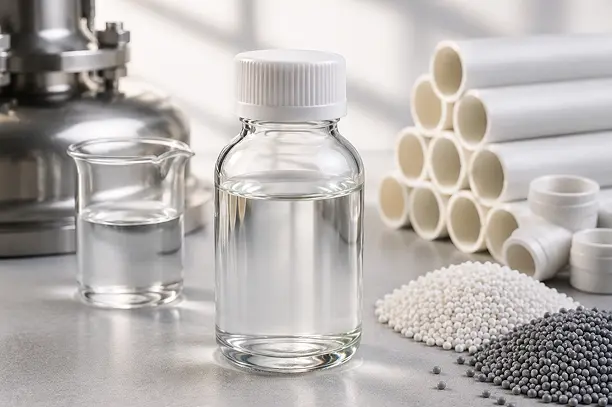
Think about the water pipes running through your walls, the transparent food packaging on a supermarket shelf, the window profiles and door frames in a modern building, or the rigid sheets used in signage and industrial equipment. Every one of these products is made from PVC — polyvinyl chloride.
And almost every one of them depends on a stabiliser added during the manufacturing process to ensure the material does not degrade under heat. Without it, PVC would discolour, become brittle, and fail long before it ever reaches the customer.
Methyl tin stabiliser is one of the most trusted and widely specified solutions to that challenge. It is a premium organotin heat stabiliser used globally in PVC processing, valued for its exceptional performance across a wide range of applications, from food packaging and medical tubing to pipes, profiles, and transparent sheets.
The methyl tin stabiliser market was valued at approximately USD 500 million in 2024 and is projected to grow at a compound annual growth rate of 5.2%, reaching USD 720 million by 2033. That growth reflects something important: this is not a product in decline. It is a chemistry that global manufacturers continue to trust and adopt.
Three qualities define why methyl tin stabiliser has earned that trust across more than 25 countries:
- Superior Thermal Stabilisation — it protects PVC from degradation at the elevated temperatures required for extrusion, calendering, injection moulding, and blow moulding
- Exceptional Optical Clarity — it maintains transparency in rigid PVC products, making it the first choice for clear sheets, films, and food-grade packaging
- Low-Dose Efficiency — under comparable performance conditions, methyl tin requires 15–20% less active content than other organotin stabilisers, delivering cost advantages at scale
What Methyl Tin Stabiliser Actually Is?
Methyl tin stabiliser belongs to the family of organotin compounds, molecules in which tin atoms are bonded to one or more organic groups. The most commercially important and widely used variant is methyl tin mercaptide, in which the methyl groups (–CH₃) are attached directly to the tin atom, and the anion component is a mercaptide (sulphur-containing) group.
This specific combination produces an exceptionally stable, highly reactive compound that interacts directly with the degradation products of PVC at processing temperatures. PVC is chemically susceptible to a well-understood and predictable degradation sequence. When exposed to heat, which is unavoidable in any melt-processing operation, PVC begins to lose hydrogen chloride (HCl) from its polymer backbone.
This process is called dehydrochlorination. It produces reactive allylic chlorines and highly reactive polyene sequences that cause discolouration (first yellowing, then browning, then blackening) and progressive loss of physical properties. Left unchecked, even brief exposure to processing temperatures above 160°C will visibly degrade unprotected PVC within minutes.
Methyl tin stabiliser interrupts this degradation by two complementary mechanisms:
- HCl Scavenging — The mercaptide group in methyl tin reacts with the HCl produced during thermal processing, neutralising it before it can catalyse further dehydrochlorination. This is the primary stabilisation mechanism — interrupting the chain reaction at its source.
- Reactive Chlorine Replacement — The tin compound exchanges its mercaptide ligands with the labile allylic chlorine atoms on the PVC backbone, directly stabilising the polymer chain at its most vulnerable points and preventing the formation of degradation-initiating polyene structures.
The tin content of the stabiliser matters significantly. The higher the tin content in the methyl tin mercaptide, the better the stabilisation performance delivered. Commercial grades commonly range from around 15% to more than 19% tin by weight.
A product with 19% tin content such as grades widely used in US, European, and Asian markets delivers benchmark thermal stability, excellent early colour hold, and outstanding dynamic heat stability across the full processing cycle.
Outstanding Performance Properties
Methyl tin mercaptide is widely recognised as the highest-performing heat stabiliser available for rigid PVC processing. That recognition is not marketing language, it is grounded in measurable technical performance across the properties that matter most to PVC manufacturers. Those properties include:
- Outstanding Compatibility With PVC formulations: Methyl tin is fully compatible with the lubricants, impact modifiers, processing aids, and other additives used in modern PVC compounding, simplifying formulation development and reducing the risk of interaction effects.
- Excellent Initial & Long-Term Colour Retention: Methyl tin provides outstanding early colour hold, preventing yellowing from the first moments of heat exposure, and sustains that stability throughout prolonged processing runs.
- Superior Dynamic Heat Stability: In dynamic processing conditions, where the material is continuously sheared and heated, as in extrusion or calendering, methyl tin maintains its stabilising action far longer than lead-based or calcium-zinc alternatives.
- Exceptional Product Transparency: Unlike many alternative stabilisers, methyl tin does not cloud or tint rigid PVC. It produces products with genuinely high optical clarity — critical for transparent packaging, clear profiles, and medical-grade applications.
- Excellent Weatherability: For outdoor applications like window profiles, siding, fencing, cladding — methyl tin stabilisers provide resistance to UV radiation, temperature cycling, and moisture. Products stabilised with methyl tin maintain their colour, strength, and surface finish over long service lives.\
- Low Dosage Requirements: The efficiency of methyl tin means lower loadings are needed to achieve the same performance as competing stabiliser systems, typically 15–20% less material than other organotin grades. This directly benefits the formulator’s economics at every batch size.
Applications: Where Methyl Tin Stabiliser Performs
The combination of high thermal stability, optical clarity, , and long-term weatherability makes methyl tin stabiliser the preferred choice across a remarkably broad range of PVC applications. The key end-use areas where methyl tin consistently delivers include:
1) Pipes & Fittings — Rigid PVC pipes, SWR/Agri pipes & fittings, CPVC pipes & fittings and UPVC pipes & fittings for drinking water supply, drainage, and industrial fluid transport depend on stabilisers that maintain long-term hydrolytic stability and meet stringent regulatory requirements for contact with potable water. Methyl tin stabilisers meet these requirements in the US, European, and major Asian markets, and are specifically approved for use in drinking water pipes and containers.
2) Transparent Sheets & Films — One of methyl tin’s greatest strengths is optical clarity. In rigid PVC transparent sheets used for packaging, display, and protective glazing, and in heat-shrinkable films and thermoformable packaging films, methyl tin produces products with minimal haze and maximum visual quality.
3) Window Profiles & Door Frames (UPVC) — Outdoor weatherable PVC profiles represent one of the most demanding stabiliser applications. The combination of UV exposure, thermal cycling, and long service life requirements, typically 20–30 years for window and door frames, demands a stabiliser with proven weatherability. Methyl tin, particularly at tin contents around 19%, is widely used in this application across the US, Europe, and the Middle East.
4) Food Packaging & Pharmaceutical Packaging — Because methyl tin mercaptide has been approved for use in food contact applications in the United States, Europe, and Japan, it is the organotin stabiliser of choice for rigid PVC used in food packaging, blister packs for pharmaceuticals, and medical device packaging. Its minimal odour and colour contribution are additional advantages in these sensitive applications.
5) Cables & Wire Insulation — Flexible and semi-rigid PVC compounds for cable sheathing and insulation also benefit from methyl tin’s thermal protection, particularly in applications where processing temperatures are elevated or long-term heat ageing performance is specified.
6) Decorative Sheets & Signage — Rigid PVC decorative sheets, printed boards, and signage panels benefit from methyl tin’s clarity and colour neutrality, ensuring that printed surfaces retain their visual quality through the processing and service life of the product.
7) Flexible Tubing, Braided Hoses & Garden Pipes — Flexible PVC products such as braided hoses, garden pipes, suction hoses, and clear flexible tubing require stabilisers that ensure excellent thermal stability, colour retention, and long-term durability during extrusion. Methyl tin stabilisers help maintain consistent processing performance and extend the service life of flexible PVC products used in agriculture, industrial fluid handling, irrigation, and household applications.
Global Reach: Serving 25+ Countries With Consistent Quality
The global demand for methyl tin stabiliser is not concentrated in a single region. It spans every major manufacturing economy in the world. PVC processing is a truly global industry and the performance requirements that methyl tin meets are universally understood, from construction-grade pipe manufacturers in South Asia to transparent packaging producers in Western Europe and automotive component suppliers across North America.
Delivering consistent methyl tin stabiliser performance across 25 or more countries requires more than a reliable chemical formula. It requires a complete commitment to quality, compliance, and service at every level:
- Rigorous quality assurance at every stage of production from raw material sourcing and tin content verification to batch consistency testing and final product certification
- Regulatory compliance across multiple jurisdictions including FDA (21 CFR) approvals for food contact applications in the United States, European regulation (EU 10/2011) for food contact plastics, and national standards for drinking water contact in individual markets
- Technical support for local formulation needs because PVC processing conditions, preferred additive packages, and end-product specifications vary by region and application
- Reliable supply chain management ensuring that manufacturing customers in diverse geographies receive consistent product specifications and timely delivery within their production schedules
The global PVC market is projected to reach approximately USD 70 billion by 2026. Within that market, stringent regulations phasing out lead-based stabilisers, already enacted in Europe and being enacted progressively in Asia, the Middle East, and South America have accelerated the adoption of methyl tin and other non-heavy-metal stabiliser systems.
This regulatory tailwind, combined with the construction and infrastructure growth driving global PVC demand, positions methyl tin stabiliser as a critical input for manufacturers building products across every inhabited continent.
From PVC stabilisers to speciality catalysts, discover products built to deliver dependable performance at SV Plastochem!
Conclusion: A Stabiliser That Earns Its Place In Every Market It Enters
Methyl tin stabiliser is not simply an additive. It is the chemical foundation that makes high-performance, food-safe, optically clear, and weatherable PVC products genuinely possible.
From the moment PVC enters an extruder to the end of a product’s twenty-year service life, methyl tin is working, neutralising the chemistry of degradation, holding colour, preserving clarity, and protecting structural integrity across every application it serves.
Its reach across 25 or more countries reflects a simple truth about performance chemistry: when a product genuinely outperforms its alternatives across the properties that matter most, manufacturers adopt it and they continue to rely on it.
The growth of the methyl tin stabiliser market to a projected USD 720 million by 2033 is not a forecast built on optimism alone. It is built on the continued, daily performance of this chemistry in pipes, profiles, packaging, and precision products that customers around the world depend on.
FAQs
1) What Is Methyl Tin Stabiliser And Why Is It Used In PVC Processing?
Methyl tin stabiliser is a premium organotin heat stabiliser used to protect PVC from degrading during high-temperature processing. When PVC is exposed to heat during extrusion, moulding, or calendering, it can release hydrogen chloride and begin to discolour, weaken, and lose performance. Methyl tin stabiliser helps prevent this degradation by neutralising the by-products of heat exposure and stabilising the polymer structure. This allows manufacturers to produce PVC products with better strength, colour retention, clarity, and long-term durability.
2) What Makes Methyl Tin Stabiliser A Preferred Choice For Manufacturers?
Methyl tin stabiliser is valued for its strong thermal stability, excellent transparency, and efficient performance at relatively low dosage levels. It helps rigid PVC maintain colour during processing, improves long-term heat stability, and supports the production of clear products such as transparent sheets, films, and food packaging. Compared with some alternative stabiliser systems, it can deliver similar or better results using lower active content. These advantages make it a practical and cost-effective choice across many PVC applications.
3) In Which PVC Applications Is Methyl Tin Stabiliser Commonly Used?
Methyl tin stabiliser is commonly used in PVC pipes and fittings, transparent sheets and films, window profiles, door frames, food packaging, pharmaceutical blister packs, cables, and decorative sheets. Its ability to provide both heat stability and optical clarity makes it especially useful in rigid transparent PVC products. It is also widely used in outdoor construction applications because of its good weatherability and long-term performance. This versatility is one reason it is trusted across multiple industries and regions.